

On an air conditioner breakdown, the contractor may take the time of the first phone call as the start, and the store manager may take the time the technician arrived. When both sides rely on their own records, the argument starts at the month-end invoice. An SLA is the service level commitment written into the contract: how fast each priority gets a response, and when each job is finished. A KPI is the measurement that shows whether the commitment was kept. When commitment and measurement come from the same record, both sides hold the same number.
ISO/TR 41030:2024 is a technical report on the current state of performance management in facility management (July 2024). In the industry survey it reports, 40% of respondents say they are measured with performance indicators. The same report says indicators can be used at operational, tactical and strategic levels. For a multi-site chain, that means one contract that carries indicators at store level (response time) and at head office level (repeat fault rate, planned maintenance compliance).
Define priority classes first
A single time commitment cannot fit every request. A power cut at the till area and a dead sign light do not get the same speed. The contract sorts requests by business impact: a fault that stops sales or food safety, a fault that disrupts service, and work that can be planned.
Hypothetical example (calibrate the times with your own store data and the contractor’s capacity):
| Priority | Example request | First response | On-site arrival | Resolution |
|---|---|---|---|---|
| Emergency | Cooling unit down, no power at the till area | 30 minutes | 4 hours | Temporary fix 24 hours, permanent fix 5 working days |
| High | One air conditioning unit not working, door lock faulty | 2 hours | 1 working day | 3 working days |
| Normal | Lighting, minor repair | 1 working day | 3 working days | 7 working days |
| Planned | Periodic maintenance | Scheduled day | Scheduled day | Completed the same day |
In the emergency class, temporary and permanent fixes are written separately. A temporary fix keeps the store operating; a permanent fix removes the root cause of the fault.
Measure first response, arrival and resolution separately
ServiceChannel’s 2026 retail healthcare facilities report draws on more than 196,400 work orders from 2024 and 2025 for multi-location sites such as dental practices, veterinary clinics and urgent care centers. The report defines emergency HVAC repairs as requests asking the provider to arrive in less than 4 hours, and it reports that resolving these jobs takes nearly 7 days on average. For a request marked emergency, the arrival expectation is counted in hours and the resolution in days. When arrival and resolution are squeezed into one number, that gap stays outside the measurement.
Five timestamps
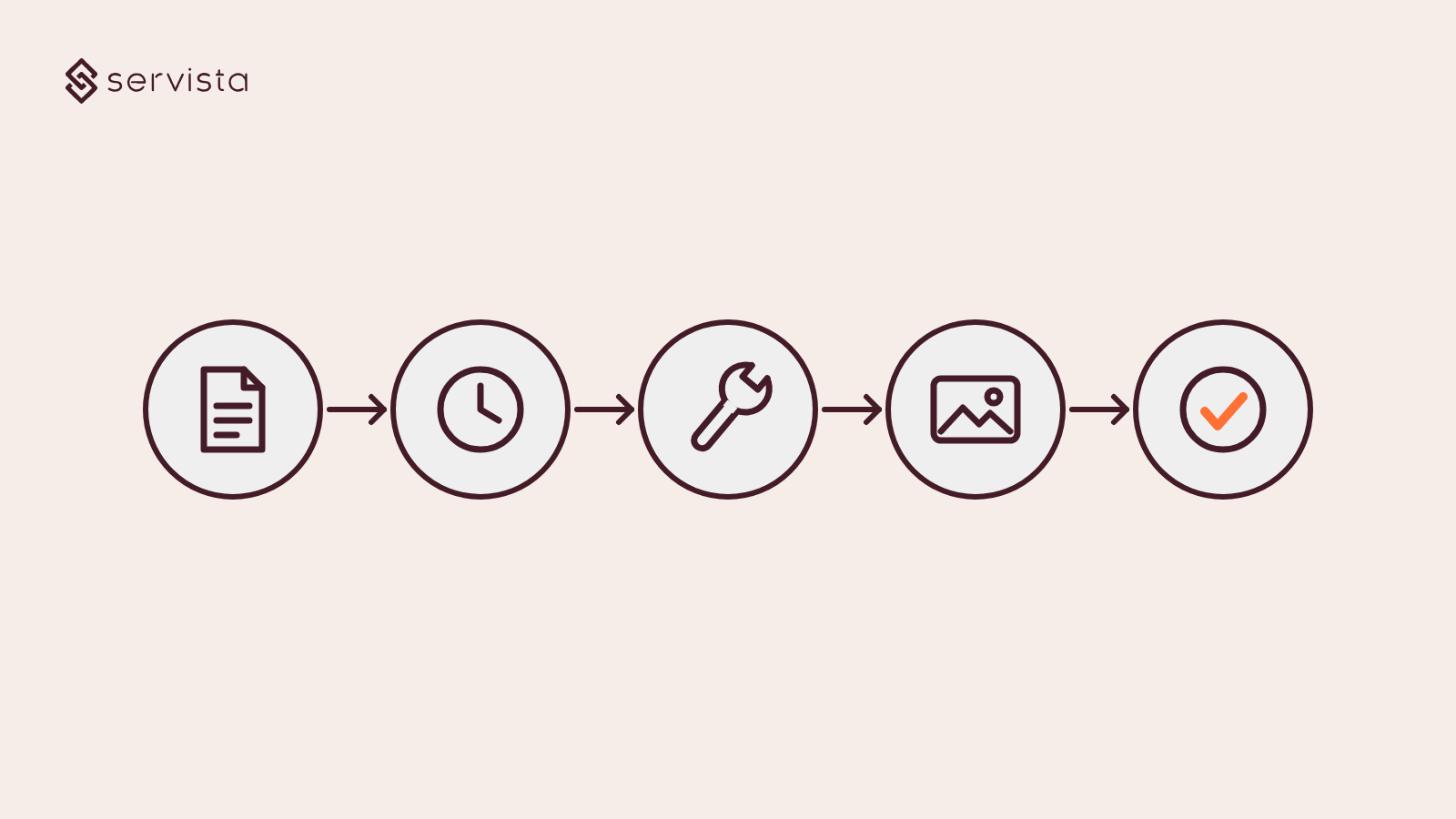
Each duration is calculated as the difference between two timestamps. Five records are kept for every request: the request being opened, the contractor accepting it, the technician arriving at the store, the job being completed with a photo report, and the store’s sign-off. First response time is the difference between the first two timestamps. Arrival time is measured between the first and the third, and resolution time between the first and the fourth. The store’s sign-off is the last step, confirming on the store’s behalf that the job is finished.
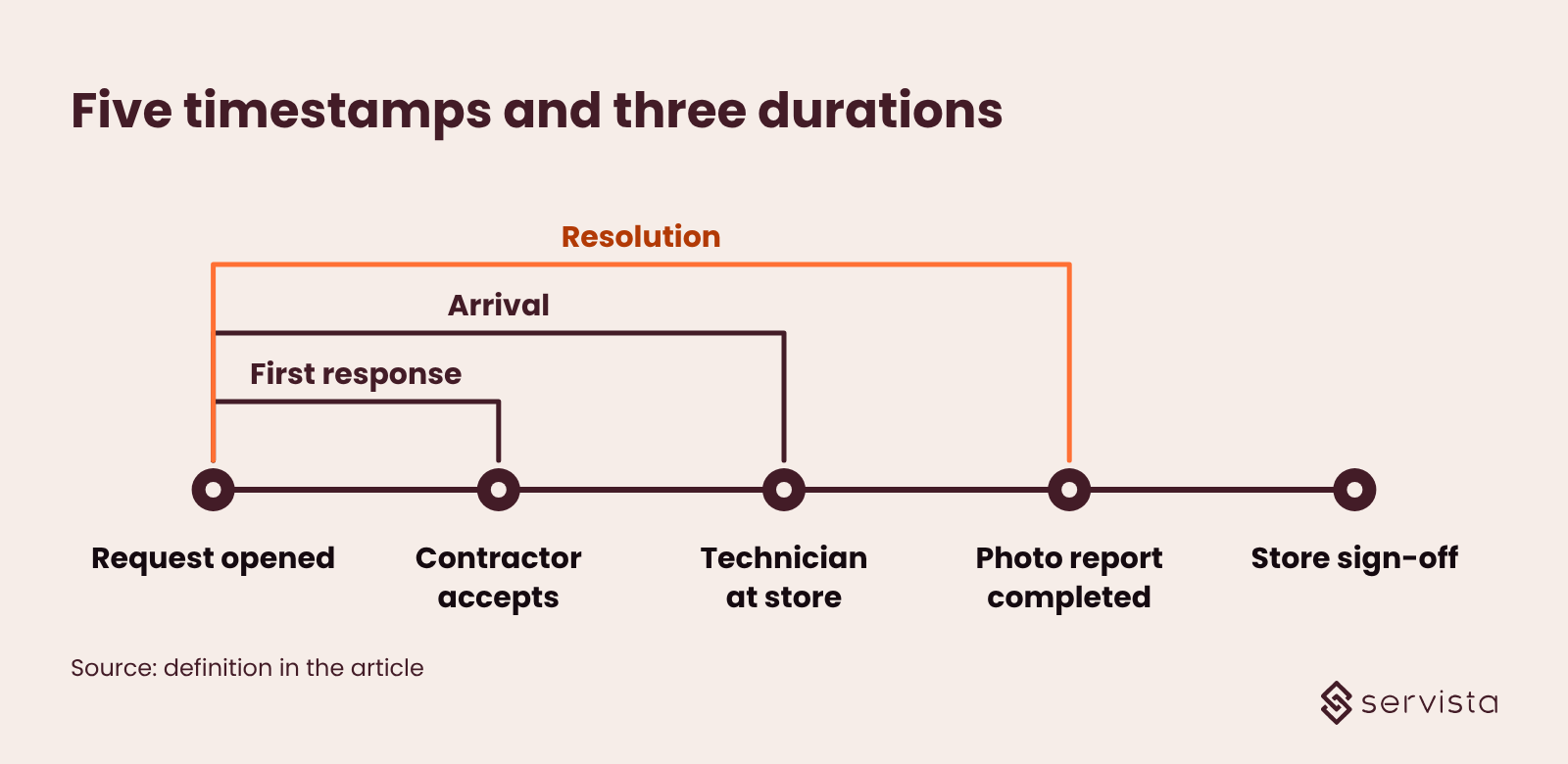
Clock-pause rules are written as well: time when the store cannot give access, and the lead time of a part order approved by the buyer. When the rules are not written down, every objection is argued one by one.
First-time fix rate
According to IBM’s article of 11 February 2026, first-time fix rate is the percentage of jobs completed on the first visit without a follow-up visit, extra parts or outside support. The formula is the number of jobs completed on the first visit divided by the total number of jobs completed, multiplied by 100. In IBM’s example, 160 of 200 calls are fixed on the first visit, which gives 80%. The contract defines “fixed on the first visit”: whether a temporary fix counts, whether a permanent fix is required, and whether waiting for a part counts as a first-visit fix.
Repeat fault rate
A repeat fault is a request reopened on the same equipment with the same fault code within a set period. The length of that window is written into the contract. The rate is the number of requests reopened in the window divided by the total number of requests closed. The two rates are read together: if a job is closed on the first visit and the same fault returns soon after, the first-time fix rate looks high, and the repeat fault rate corrects that picture.
Planned maintenance compliance and open job age
In the ServiceChannel report, reactive repairs make up 44% of budgets at retail healthcare facilities. The US Department of Energy’s Federal Energy Management Program (FEMP) O&M Best Practices Guide (Release 3.0, August 2010) gives an estimated 12% to 18% cost saving for a preventive maintenance program over reactive maintenance. The guide covers equipment in US federal facilities and dates from 2010, so the range cannot serve as a target for stores in Türkiye. It can be read as a reason to measure planned maintenance as a separate indicator in the contract.
Two indicators cover this area. Planned maintenance completion rate is the share of scheduled maintenance tasks completed on time. Open job age is the average and the oldest age of open work orders; the oldest open work order shows the waiting job that the average hides.
Pick few indicators and define the formulas in an annex
The UK Cabinet Office’s KPI guidance under the Procurement Act 2023 (page updated 20 July 2026) requires at least three KPIs for public contracts above 5 million pounds, and requires performance to be assessed at least once in every twelve months during the contract and on termination. The guidance uses five rating levels: Good, Approaching target, Requires improvement, Inadequate, and Other for periods with no data recorded. This rule applies to public contracts; in a private sector maintenance contract it can serve as a reference for the lower bound and the assessment frequency.
The European standard EN 15341 can supply the formulas. The standard (2019 edition, with A1:2022) lists the key performance indicators of the maintenance function and gives guidance on choosing a suitable set. A starter set can consist of six indicators:
| Indicator | Formula | Data source |
|---|---|---|
| First response compliance | Requests responded to within time / total requests (by priority class) | Request and acceptance timestamp |
| On-site arrival compliance | Requests attended within time / total requests | Store arrival record |
| Resolution compliance | Requests resolved within time / total requests | Completion and store sign-off |
| First-time fix rate | Jobs finished on the first visit / total jobs finished | Work order visit record |
| Repeat fault rate | Requests reopened within the window / total requests closed | Equipment and fault code |
| Planned maintenance completion rate | Planned maintenance completed on time / planned maintenance scheduled | Maintenance calendar and work order |
Reporting is monthly and the indicator set is reviewed yearly. Target values are set from actual data after an initial period of measurement only.
Who holds the measurement data
If timestamps are kept in the contractor’s own system, the measurement depends on the contractor’s report. A shared record that the buyer can also access removes the need to compare two separate reports at month end. In Servista, the service request, photo report and work order are kept in one record with timestamps; that record can serve as the shared data source for SLA measurement.
Measurement can be distorted in these ways: closing a job before it is done, splitting one fault into two requests, lowering the priority afterwards. The contract answers with the store’s sign-off, a photo completion record, and a rule that only the buyer can change a priority. The repeat fault rate makes jobs that were closed on paper but not solved visible.
Penalty and incentive mechanism
The outcome of an SLA can be written in two directions: a payment deduction or service credit for performance below target, and a bonus for performance above it. The penalty clause is regulated in Articles 179 to 182 of the Turkish Code of Obligations. Have the deduction rates and the cap reviewed by your legal counsel before writing them into the contract; this article is not legal advice.
Hypothetical example
The numbers are illustrative. Of 200 emergency requests in a month for a restaurant chain, 170 received a response within time (85%). In that month 180 requests were closed and 126 of them were fixed on the first visit (70%). Of the 180 closed requests, 27 were reopened within 30 days on the same equipment with the same fault code (15%).
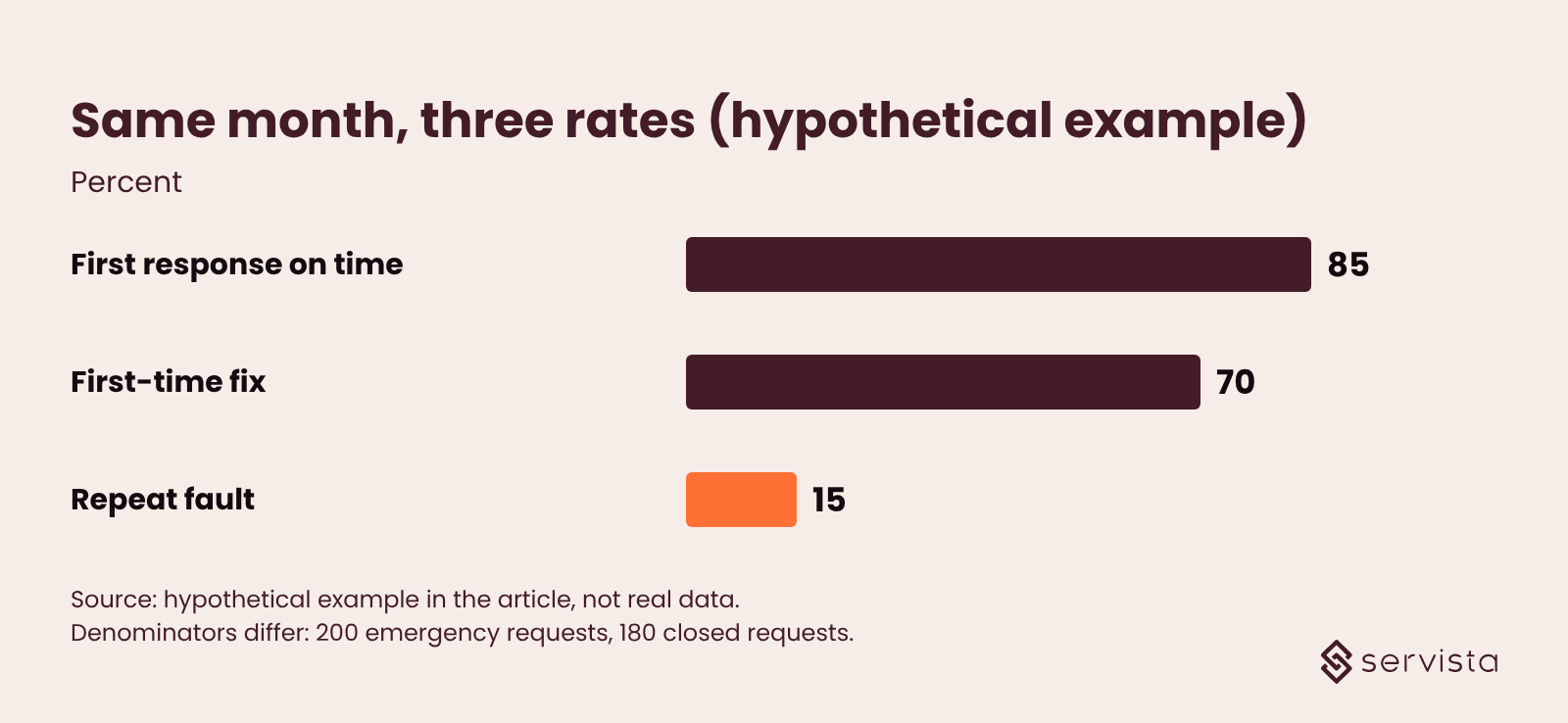
If the payment formula depends only on response time compliance, the contractor can collect points through fast but non-lasting responses. Adding the first-time fix and repeat fault rates to the formula makes that behavior more expensive.
Contract checklist
- Priority classes and example requests for each class are defined in a contract annex.
- First response, on-site arrival and resolution times are written separately, with the timestamps they are calculated from.
- Clock-pause conditions are written down.
- First-time fix and repeat fault have a definition and a window length.
- The planned maintenance calendar and the completion measure are defined.
- Measurement data comes from a shared record that the buyer can also access.
- The rule that only the buyer can change a priority is written down.
- Reporting frequency and the yearly review of the indicator set are written down.
- Payment deductions, incentives and the cap have been reviewed by legal counsel.
Sources
- ISO/TR 41030:2024, Facility management, Existing performance management in facility management organizations, State of the industry (July 2024): https://standards.iteh.ai/catalog/standards/iso/49c1c6e4-45c6-4111-a672-0f54aba2aca1/iso-tr-41030-2024
- Cabinet Office, Guidance: Key Performance Indicators (updated 20 July 2026): https://gov.uk/government/publications/procurement-act-2023-guidance-documents-manage-phase/guidance-key-performance-indicators-html
- ServiceChannel, 2026 Retail Healthcare Facilities Benchmark Report: https://servicechannel.com/fr/wp-content/uploads/2026/08/Benchmark-Report-Retail-Healthcare-Facilities-2026-DIGITAL.pdf
- IBM, What is first-time fix rate (FTFR)? (11 February 2026): https://www.ibm.com/think/topics/first-time-fix-rate
- US Department of Energy FEMP, Operations and Maintenance Best Practices Guide, Release 3.0 (August 2010): https://www.energy.gov/sites/default/files/2020/04/f74/omguide_complete_w-eo-disclaimer.pdf
- EN 15341:2019+A1:2022, Maintenance, Maintenance key performance indicators: https://standards.iteh.ai/catalog/standards/cen/fd8282fc-5fa6-4b32-b7ce-e5e3d6d735ec/en-15341-2019a1-2022
- Law No. 6098, Turkish Code of Obligations: https://csgb.gov.tr/Media/xgjbrxit/6098-say%C4%B1l%C4%B1-bor%C3%A7lar-kanunu.pdf
This article contains general information and is not legal advice.